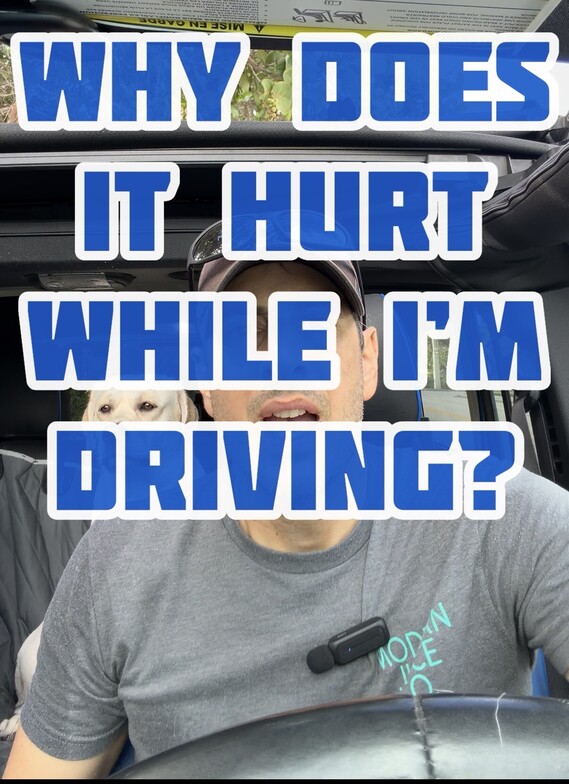
Back Pain and Sciatica While Driving? Here’s Why
Does your lower back start hurting when you drive? Maybe you’re comfortable when you first get into the car, but after 20 or 30 minutes, you begin to notice pain in your lower back, buttock, or even shooting down your leg.
If this sounds familiar, your car seat and driving position may be contributing to your symptoms.
Why Can Driving Aggravate Sciatica?
Sciatica generally refers to pain that travels along the path of the sciatic nerve, often beginning in the lower back or buttock and extending down the leg. When a nerve in the lower back is already irritated or sensitive, certain positions can make those symptoms more noticeable.
Driving combines several factors that may aggravate back and leg pain.
1. Bucket Seats Can Change Your Lower Back Position
Many cars, especially sports cars and vehicles with low or bucket-style seats, position your hips lower and place you in a more reclined posture.
This can cause the pelvis to roll backward and increase flexion or rounding of the lower back. For someone whose symptoms are sensitive to lumbar flexion or prolonged sitting, this position may increase irritation and contribute to pain traveling into the buttock or leg.
2. Prolonged Sitting
Even with a good seat, simply sitting for an extended period can be problematic.
Driving requires you to maintain essentially the same position for long periods. Unlike sitting at home or at your desk, you can't easily stand up, walk around, or frequently change positions.
If a nerve in the lower back is already irritated, prolonged sitting may increase symptoms over time.
3. Your Driving Leg Stays Extended
Think about the position of your right leg while driving. It remains extended forward to operate the gas and brake pedals.
Depending on your seat position and underlying condition, this posture may increase tension along the sciatic nerve and contribute to symptoms traveling down the leg.
Sitting too far away from the pedals may make this even more noticeable because you have to reach farther with your leg.
4. Road Vibration
Your lower back is also exposed to continuous vibration from the vehicle and road.
Although you may barely notice it, prolonged vibration combined with sitting in one position may further aggravate an already sensitive lower back or nerve.
5. Getting In and Out of the Car
Sometimes the problem isn't just the driving itself.
Getting into and out of a low vehicle often requires a combination of bending and rotating through the lower back. If your back is already irritated after a long drive, this movement can sometimes trigger another increase in symptoms.
Do You Feel Better Once You Start Walking?
One important clue is what happens after you get out of the car.
If your back or shooting leg pain increases the longer you drive but begins to improve once you stand up and start walking, your seated driving position may be contributing to your symptoms.
This doesn't necessarily identify the exact cause of your pain, but it can provide useful information during an examination.
How Can You Make Driving More Comfortable?
A few simple adjustments may help:
-
Bring your seat closer to the pedals so you aren't reaching with your driving leg.
-
Sit slightly more upright rather than excessively reclined.
-
Use appropriate lumbar support to help maintain a comfortable lower-back position.
-
Adjust the seat height and angle when possible.
-
Avoid sitting on bulky objects, such as a wallet, that may change your pelvic position.
-
During longer drives, take regular breaks to stand and walk.
The best driving position can vary depending on what is causing your symptoms, so there isn't one seat setup that works for everyone.
When Should You Have It Evaluated?
Occasional lower back stiffness after a long drive is one thing. However, pain that repeatedly shoots from your back or buttock down your leg may indicate irritation of a lumbar nerve and deserves further evaluation, particularly if symptoms are persistent or worsening.
If you develop significant leg weakness, progressive numbness, numbness around the groin or saddle region, or changes in bowel or bladder control, seek prompt medical attention.
If driving consistently aggravates your back or leg pain, identifying why the nerve is irritated and which positions are provoking it can help determine the most appropriate treatment and rehabilitation approach.

Dr. Steve Muscari
Contact Me