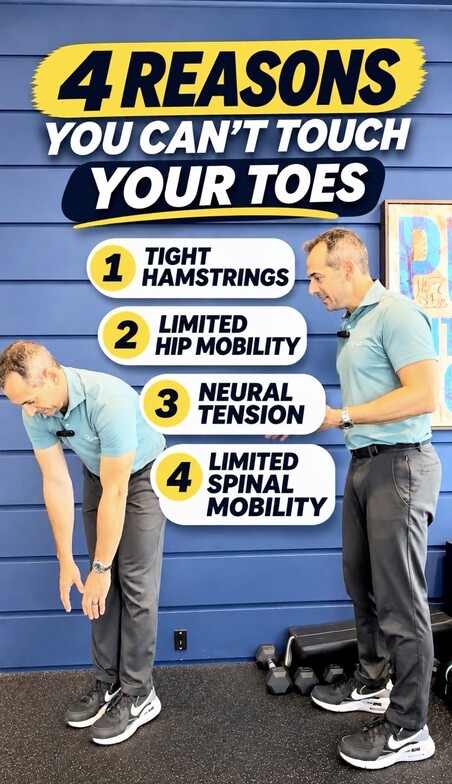
Can't touch your toes? Before you start blaming your tight hamstrings, you should know there's more to it than that!
Touching your toes might seem like a simple movement, but it actually requires several parts of your body to work together. Your hamstrings, hips, lower back, nervous system, and overall movement control all play a role.
If you've been stretching your hamstrings for years and still can't reach your toes, you might be focusing on the wrong problem.
Let's break down four reasons why you might be struggling.
1. Tight Hamstrings
This is the most obvious reason, and yes, tight hamstrings can absolutely limit your ability to touch your toes.
Your hamstrings run along the back of your thighs, connecting your pelvis to your lower legs. When these muscles have limited flexibility, they can restrict how far you bend forward, particularly when your knees are straight.
What can help?
-
Boot Strap Stretch
-
Supine Hamstring Stretch
-
Dynamic Hamstring Stretch
Rather than aggressively pulling on your hamstrings, focus on controlled movements and gradually increasing your range of motion.
2. Increased Nerve Tension
Here's something many people don't consider: what feels like tight hamstrings might actually involve your nervous system.
Your sciatic nerve travels from your lower back through your glutes and down the back of your legs. As you bend forward, your nervous system needs to accommodate the movement.
If the nerves are sensitive or aren't gliding comfortably through the surrounding tissues, you might experience pulling, tightness, or discomfort along the back of your legs.
This doesn't necessarily mean your hamstrings are short or tight.
What can help?
Neuro Glides, also called nerve flossing exercises, encourage gentle movement of nerves relative to surrounding tissues.
The key is to perform these movements slowly without aggressively stretching or provoking symptoms.
3. Limited Hip Mobility
Your hips play a major role in your ability to bend forward.
When touching your toes, a significant portion of the movement should come from hinging at your hips.
If you struggle to move your pelvis forward over your thighs, you may compensate by rounding your back excessively or bending your knees.
Improving hip mobility and learning how to properly hinge can make a noticeable difference.
What can help?
-
Hip Hinge Drills
-
Standing Forward Fold
-
Dynamic Hip Mobility Exercises
Sometimes improving how you move is just as important as improving how flexible you are.
4. Limited Spinal Mobility and Movement Control
Your spine also contributes to the toe-touch movement.
If your lower back or other areas of your spine are stiff, you may have difficulty moving smoothly through a forward bend.
Additionally, some people have enough flexibility but struggle to coordinate their hips, spine, and pelvis effectively.
This is where controlled spinal mobility exercises can be helpful.
What can help?
-
Jefferson Curl
-
Cat-Cow
-
Segmental Spinal Flexion
The Jefferson Curl is a progressive exercise that encourages controlled spinal flexion while also challenging the posterior chain. Start without weight and gradually progress only when you can perform the movement comfortably and with good control.
So, How Do You Improve Your Toe Touch?
The answer isn't necessarily stretching your hamstrings more.
First, try to identify what's limiting your movement. Is it muscle flexibility, nerve sensitivity, hip mobility, spinal stiffness, or a combination of these factors?
Once you have a better understanding, you can choose exercises that address those specific limitations.
Three exercises worth exploring include:
1. Boot Strap Stretch: Helps improve hamstring flexibility and hip mobility.
2. Neuro Glides: Encourage gentle nerve movement and may help when nerve sensitivity contributes to restricted motion.
3. Jefferson Curl: A progressive exercise that develops controlled spinal movement and flexibility.
These exercises aren't appropriate for everyone. If bending forward causes sharp pain, radiating symptoms, numbness, or tingling, avoid forcing the movement and consider getting evaluated.
Final Thoughts
Not being able to touch your toes doesn't automatically mean something is wrong with your body. And being able to touch your toes isn't necessarily a measure of how healthy your back is.
However, if improving your flexibility and mobility is one of your goals, understanding what's limiting your movement is a great place to start.
Remember, it's not always about stretching more. Sometimes it's about moving better.
Dr. Steve Muscari
New Path Chiropractic – Wellness & Sports Rehab
Jupiter, Florida

Dr. Steve Muscari
Contact Me