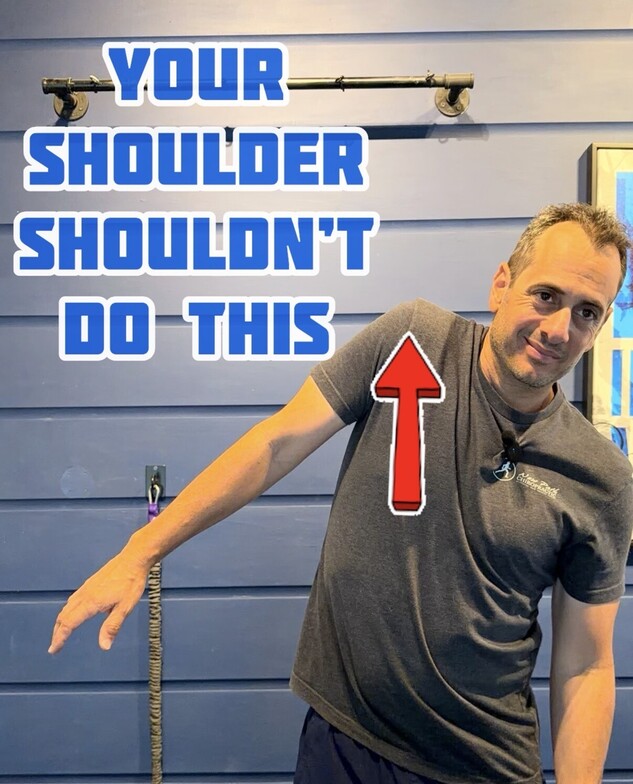
Have you ever looked in the mirror while raising your arm and noticed that your shoulder hikes or shrugs toward your ear? This compensation is sometimes referred to as the shoulder shrug sign, and it can be an indication that the shoulder isn’t moving or stabilizing as efficiently as it should.
Why Does the Shoulder Shrug?
Normal shoulder movement requires several muscles to work together.
When your deltoid muscle contracts to raise your arm, its force doesn’t simply pull the arm outward. Part of the deltoid’s force vector also pulls the head of the humerus upward.
This is where the rotator cuff becomes extremely important.
The rotator cuff helps compress and center the head of the humerus within the shoulder socket while the deltoid raises the arm. Together, the deltoid and rotator cuff create a coordinated force couple that allows the shoulder to move smoothly.
If the rotator cuff is painful, weak, or injured, this balance can become disrupted. Your body may compensate by using more of the upper trapezius and elevating the shoulder blade to help get the arm overhead. This creates the noticeable shrugging or hiking motion.
A shoulder shrug sign doesn't automatically mean you have a rotator cuff tear. Pain, weakness, restricted shoulder motion, and other shoulder conditions can also contribute.
Exercises to Improve Shoulder Stability
Treatment depends on what is causing the abnormal movement, but strengthening the rotator cuff and improving shoulder and scapular control can often be an important part of rehabilitation.
Kettlebell Shoulder Stabilization
Here’s a great shoulder stabilization exercise using a kettlebell. Holding a light kettlebell overhead challenges your rotator cuff and surrounding stabilizing muscles to maintain control of the shoulder joint. Keep the weight light, stay controlled, and avoid letting your shoulder shrug toward your ear.
Resistance Band Shoulder Stabilization
Resistance bands are another great way to challenge shoulder stability. The band creates constant tension while you move, requiring the rotator cuff and surrounding shoulder stabilizers to work together to control the joint. Focus on slow, controlled movement rather than using heavy resistance.
Prone Shoulder Exercise
Prone shoulder exercises are performed lying face down and can be used to strengthen the muscles responsible for controlling the shoulder blade and shoulder joint. Keep the movement controlled and concentrate on proper shoulder positioning without excessively shrugging toward your ear.
Control Before Strength
When working on shoulder rehabilitation, more weight isn't necessarily better. Proper movement and control should come first.
If you notice your shoulder hiking toward your ear during an exercise, consider decreasing the resistance or range of motion. The goal is to gradually improve your ability to raise and stabilize the arm without relying on excessive compensation.
If you consistently shrug your shoulder when raising your arm—or you're experiencing shoulder pain, weakness, or difficulty reaching overhead—it may be worth having the shoulder evaluated to determine why the compensation is occurring.
At New Path Chiropractic – Wellness & Sports Rehab, we evaluate shoulder mechanics and develop individualized treatment and rehabilitation programs designed to restore strength, mobility, and proper movement.

Dr. Steve Muscari
Contact Me