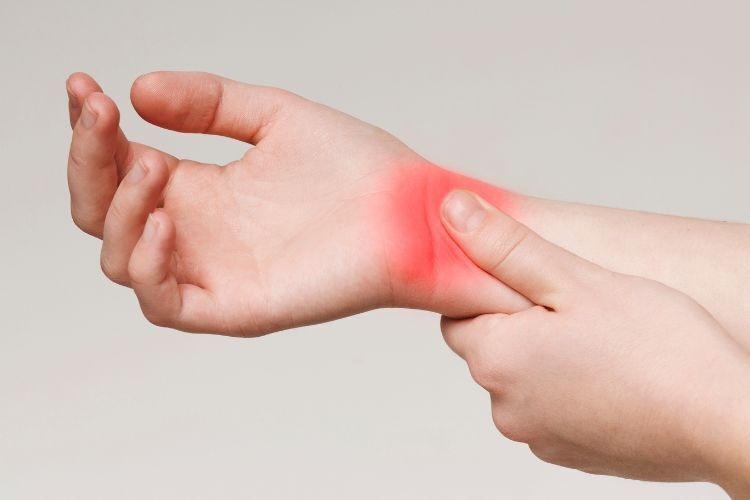
Wrist pain that wakes you up at night. Tingling in your fingers that won't quit. A grip that feels weaker than it used to. If any of that sounds familiar, carpal tunnel syndrome might be the reason. It's one of the most common nerve conditions we see at New Path Chiropractic in Jupiter, FL, and it affects far more than just people who sit at a desk all day. Golfers, pickleball players, mechanics, and anyone who relies on their hands for repetitive tasks can end up with it.
The good news is that most people don't need surgery. With the right approach, conservative care can resolve carpal tunnel symptoms and get you back to doing what you love.
What Is the Carpal Tunnel?
The carpal tunnel is a narrow passageway on the palm side of your wrist, formed by the carpal bones on three sides and a tough band of connective tissue called the flexor retinaculum on the fourth. Running through that tunnel are nine tendons and, importantly, the median nerve.
The median nerve is responsible for sensation in your thumb, index finger, middle finger, and part of your ring finger. It also controls the small muscles at the base of your thumb that allow you to pinch and grip. When the tunnel becomes crowded or inflamed, the median nerve gets compressed, and that compression produces the symptoms most people associate with carpal tunnel syndrome.
What Causes Carpal Tunnel Syndrome?
Carpal tunnel develops when pressure on the median nerve increases beyond what the nerve can handle. Several things can drive that pressure up:
Repetitive hand and wrist motions are the most common culprit. Gripping a golf club, typing for hours, using vibrating tools, or making the same throwing motion repeatedly all create cumulative load on the wrist structures.
Anatomical factors play a role too. Some people simply have a smaller carpal tunnel than others, making them more vulnerable to compression even with normal levels of activity.
Systemic conditions like diabetes, hypothyroidism, rheumatoid arthritis, and pregnancy can all increase fluid retention or nerve sensitivity in ways that make carpal tunnel more likely. Women are also three times more likely than men to develop carpal tunnel syndrome, partly due to hormonal factors and partly due to differences in tunnel anatomy.
Wrist posture matters as well. Positions that place the wrist in extreme flexion or extension, like sleeping with your wrist bent or holding a phone for long periods, can temporarily increase pressure in the tunnel.
How to Recognize Carpal Tunnel Syndrome
The classic symptoms are:
- Numbness or tingling in the thumb, index, middle, and ring fingers (but not the little finger, which is served by a different nerve)
- Pain in the wrist or hand, sometimes traveling up the forearm
- Symptoms that are worst at night or first thing in the morning
- Weakness or clumsiness in the hand, especially when pinching or gripping
- A tendency to drop things
Two simple tests are commonly used to screen for carpal tunnel. Tinel's sign involves tapping over the carpal tunnel at the wrist to see if it produces tingling in the fingers. Phalen's test involves holding the wrists in full flexion for 60 seconds to see if symptoms appear. Neither test is definitive on its own, but together with your history they paint a clear picture.
Why Conservative Care Should Come First
Surgery for carpal tunnel (carpal tunnel release) is one of the most frequently performed procedures in the country, but it isn't always the right first step. A significant number of patients who undergo surgery still experience residual symptoms, and conservative care produces comparable outcomes for mild to moderate cases.
Before any surgical conversation, it's worth exploring whether the nerve compression can be addressed through soft tissue work, joint mobilization, and activity modification.
How Chiropractic Care Treats Carpal Tunnel
At New Path Chiropractic, Dr. Steve Muscari uses a hands-on, functional approach that looks at the entire upper extremity, not just the wrist.
Active Release Technique (ART) is one of the most effective tools available for nerve entrapments like carpal tunnel. The median nerve doesn't only pass through the wrist. It travels from the neck, through the shoulder, down the arm, and into the hand. Compression or adhesion at any point along that path can contribute to or worsen carpal tunnel symptoms. ART works by applying targeted tension to the soft tissues surrounding the nerve while the patient moves through specific ranges of motion, releasing the restrictions that are choking the nerve's ability to glide freely.
Graston Technique uses specialized stainless steel instruments to detect and treat areas of scar tissue and fibrosis in the tendons and fascia around the wrist. This can significantly reduce the tissue congestion that contributes to tunnel compression.
Wrist and cervical joint mobilization addresses the joint mechanics that often accompany carpal tunnel. Stiff wrist joints alter load distribution through the carpal tunnel, and restrictions in the neck can create what's called double crush syndrome, where the nerve is compressed at multiple points simultaneously.
Movement and ergonomic assessment through the SFMA framework helps identify whether faulty movement patterns upstream (shoulder mechanics, thoracic rotation, grip habits) are contributing to the problem at the wrist.
What You Can Do in the Meantime
A few strategies can help manage symptoms while you're working through treatment:
Splinting at night keeps the wrist in a neutral position and prevents the unconscious flexion that drives nighttime symptoms. A simple off-the-shelf wrist splint worn while sleeping can make a meaningful difference in sleep quality while healing progresses.
Nerve gliding exercises encourage the median nerve to move freely through the carpal tunnel rather than becoming stuck. These are gentle exercises that your chiropractor can walk you through and are often used as part of a home care program.
Reducing or modifying provocative activities temporarily gives the nerve time to decompress. This doesn't mean stopping everything, but it does mean paying attention to which tasks make symptoms worse and adjusting grip, posture, or frequency where possible.
Getting Back to Full Function
Carpal tunnel syndrome doesn't have to become a chronic problem. Caught early and treated correctly, most people see significant improvement within a few weeks to a couple of months. Even longer-standing cases often respond well to conservative care when the underlying drivers are properly addressed.
If you've been dealing with wrist pain, hand numbness, or grip weakness in Jupiter, Palm Beach Gardens, or the surrounding area, Dr. Steve Muscari can assess what's actually going on and put a plan together to fix it. With 15 years of clinical experience, advanced soft tissue certifications, and a one-on-one approach to every patient, New Path Chiropractic is built for exactly this kind of problem.
Book a consultation at newpathhealth.com and let's get your hands working the way they should.